
At The Edu Experience, our primary Science programme is designed to build strong conceptual understanding and confident application of scientific knowledge. Through clear explanations, structured practice, and expert guidance, we help students grasp key concepts, answer open-ended questions accurately, and approach Science with confidence–supported by our unlimited tuition model that allows learning to progress at the right pace.
What is Unlimited Tuition?
Unlike typical tuition centres, TEE students can attend up to four classes a week at no extra cost, allowing for regular practice, immediate clarification of doubts, and repeated exposure to key concepts. Unlimited tuition at TEE gives students the flexibility to learn without being restricted by once-a-week lessons. This consistent support helps learning deepen over time, builds confidence, and ensures students progress at a pace that truly suits their needs.
Why Unlimited Tuition?
Children learn best through repetition, practice, and the freedom to try again. Unlimited tuition supports learning in the same way. Just like learning to ride a bike or feed themselves, children do not master new skills immediately; they wobble, make mistakes, and improve with each attempt.
Science learning benefits greatly from the repeated application of concepts rather than one-off exposure. With unlimited tuition, students can practise a wide range of open-ended questions, refine their use of scientific keywords, and strengthen explanation skills through regular feedback.
How Does Unlimited Science Tuition Benefit Students?
With unlimited lessons, students can revisit challenging topics, practise a wide range of open-ended questions, and receive immediate feedback on their use of scientific keywords and explanations. This repeated exposure helps students sharpen their answering techniques, avoid common mistakes, and gain confidence in tackling higher-order questions under exam conditions.

How Does It Work?
STEP 01
Reserve a Fixed Weekly Class
Reserve 1 fixed, weekly Primary Science tuition class.
STEP 02
Book Extra Classes
Struggling with a specific topic like Heat or Water and Changes of State?
Book up to three extra tuition classes during the week to reinforce these concepts at no extra cost.
STEP 03
Get Extra Support
Need extra support?
Book a consultation slot* (Science consultations are conducted on Wednesdays), and receive 1-on-1 guidance with a dedicated Science teacher.
We know that life is busy. That’s why we built our own app that allows you to manage bookings easily.
*Consultations are only available at our Tampines location.
Our Methodology: Inquiry-Based Learning
“Tell me and I forget, teach me and I may remember, involve me and I learn.” – Benjamin Franklin
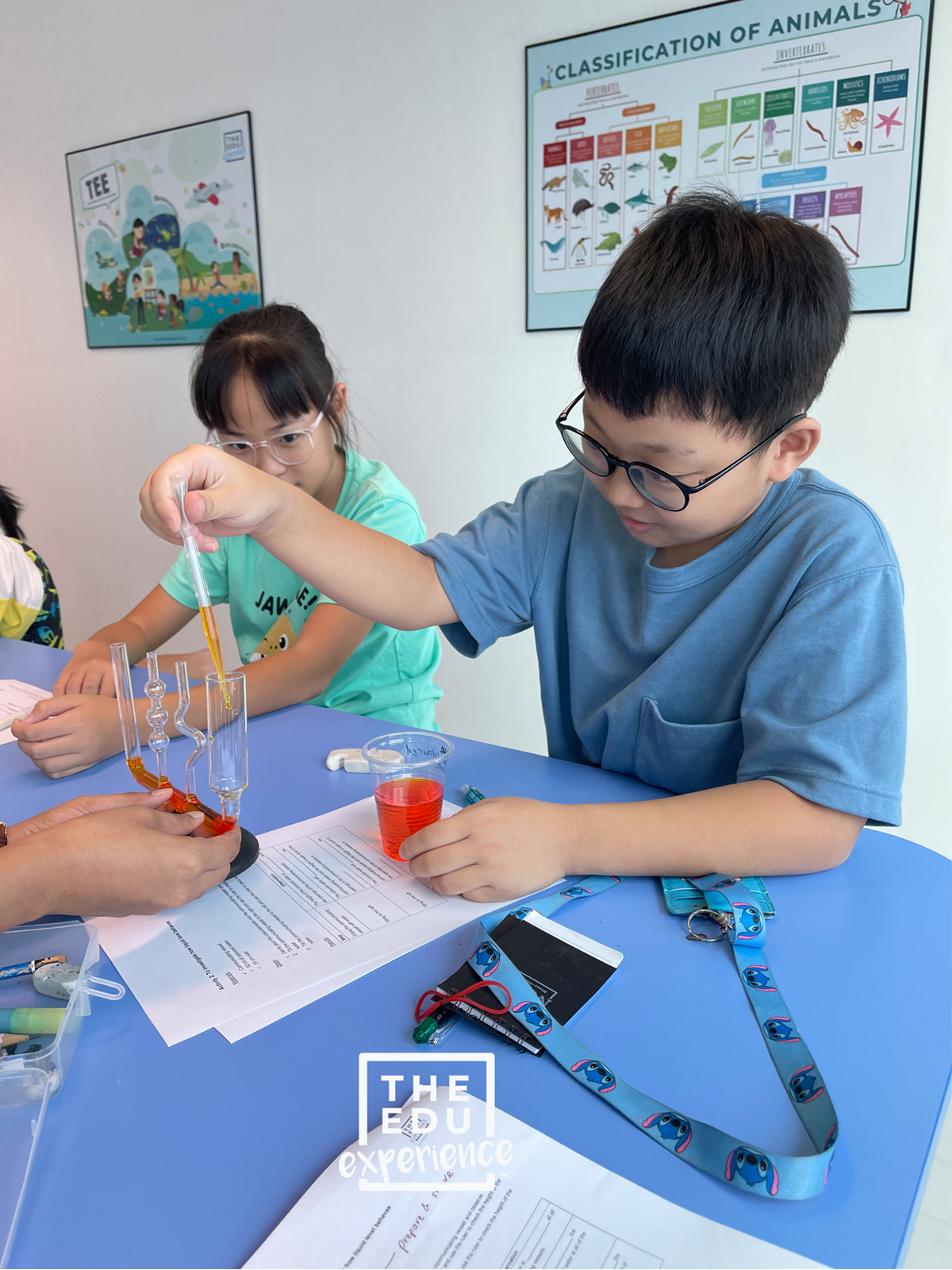
We strongly believe in adopting an inquiry-based approach. We have created a fun and safe learning environment where students can explore new ideas with confidence, make mistakes without fear, and develop a genuine love for learning.
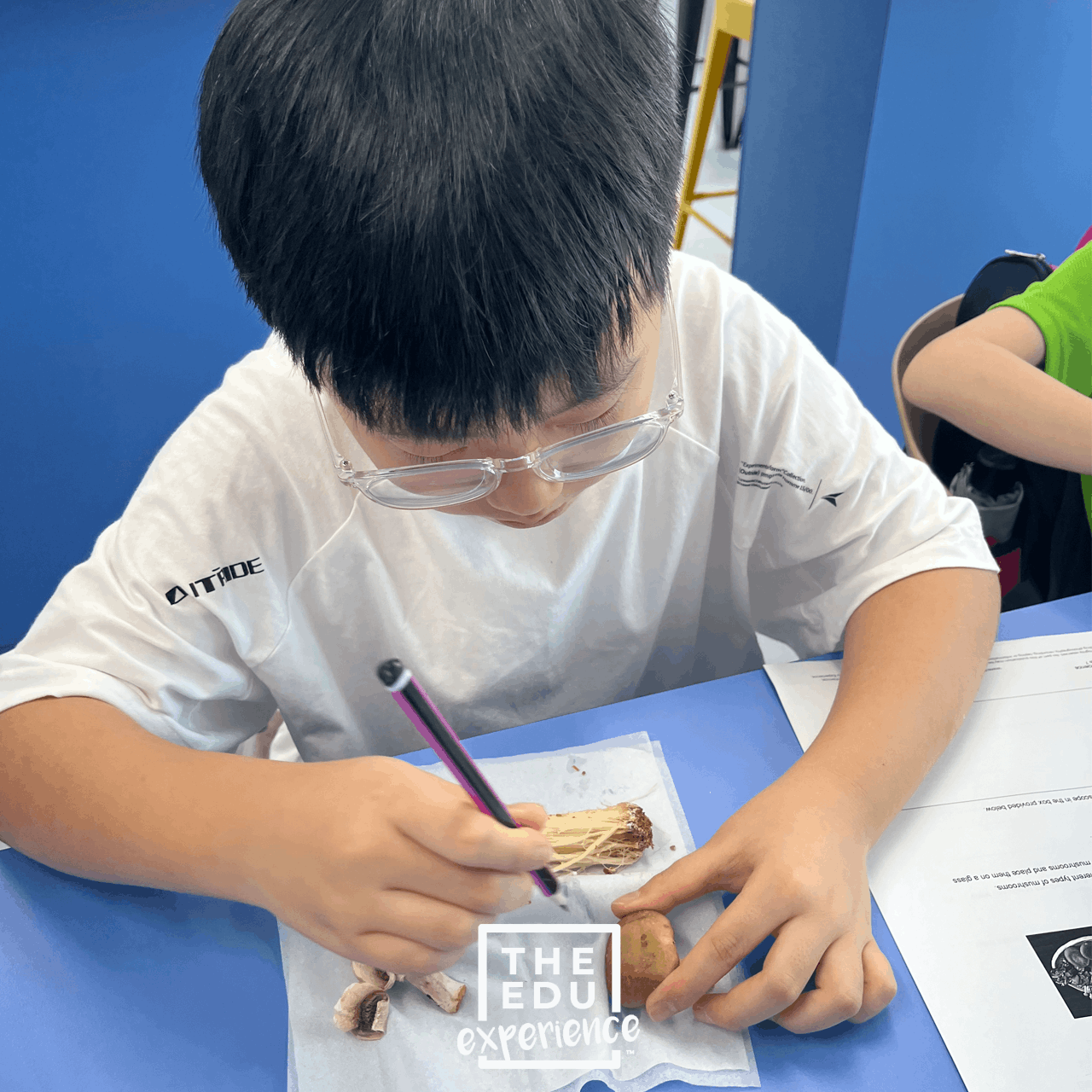
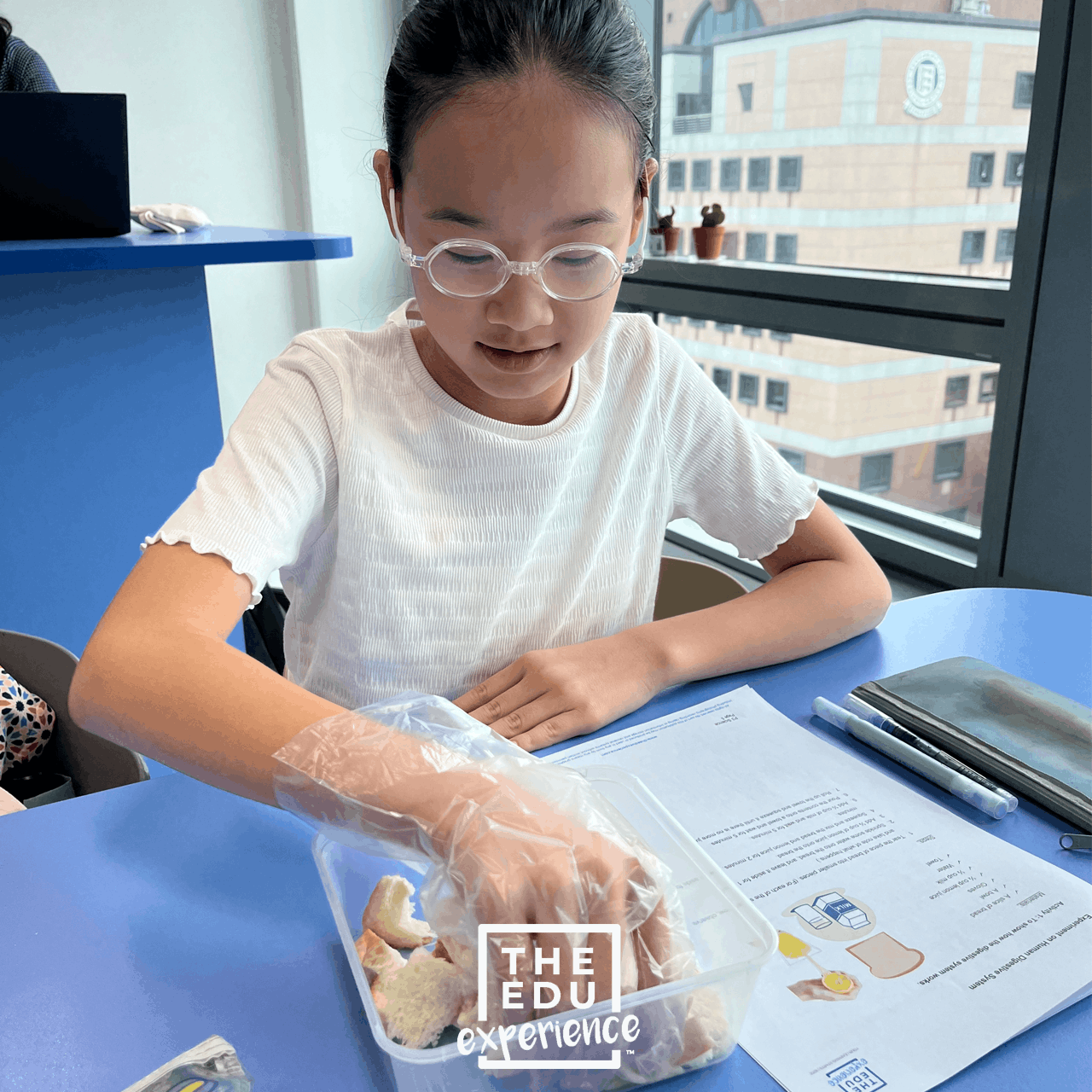
We conduct fun-filled Science experiments to enhance the understanding of concepts through hands-on learning. Children are naturally more engaged, leading to better retention. We also utilise various online tools coupled with our curated questions to test knowledge and reinforce important concepts. Students are equipped with the skills needed to relate Science knowledge to daily life, making learning fun and relevant.

Our Curriculum: The TEE CODE Framework
Primary 2: The “Head Start” Programme
The Goal: Nurturing curiosity before school starts.
Although P2 students have not been introduced to Science in school, we offer a P2 Science Introductory Programme that runs annually from August to October. This 3-month programme gives students a platform to acquire soft skills like note-taking and how to conduct experiments.
The TEE CODE Framework: Every lesson is distilled and simplified for young learners using our proprietary framework:
C – Curiosity: Look up high and far, what can you see?
O – Observation: Look around you, what can you see, hear, smell, feel, and taste?
D – Discovery: Looking in, what will we discover?
E – Exploration: Looking down, what uncharted territories can we explore?
Outcome: Students enrolled in this programme will be ahead of their peers and ready to take on Science as an official subject in P3.
Primary 3-4: The 3 “INs” of Science
The Goal: Developing critical thinking skills and answering techniques.
We introduce scientific concepts through fun lessons to pique curiosity. Our teachers aim to INspire a love for learning, encourage students to INquire like scientists through investigation, and INnovate by applying concepts to solve problems.
We guide students towards asking the right questions and arriving at conclusions independently, and we train students to answer Primary Science exam questions using the right answering techniques and keywords. This allows them to tackle weighted assessments with confidence.
Primary 5-6: Preparing for the PSLE
The Goal: Consolidating knowledge and answering open-ended questions.
Primary 5 is a crucial year where advanced concepts are introduced. Our upper primary programme helps students internalise complex concepts and processes. Our Science worksheets are curated by experienced teachers familiar with the latest MOE Science syllabus.
Students are trained to analyse questions and use accurate scientific terms to score in both multiple-choice and open-ended questions. They write their own summary of each topic with guidance, and make connections between the various topics that they have learnt. We also help students develop their reasoning and problem-solving skills so that they have the flexibility to respond to different contexts (a key requirement for PSLE).
Developing Exam Readiness: Science Mock Exam Papers
The Problem: Students often receive insufficient and imprecise feedback from schools following exams. Without understanding why they lost marks, they cannot improve.
Our Solution:
Developing Exam Readiness: Science Mock Exam Papers
The Problem: Students often receive insufficient and imprecise feedback from schools following exams. Without understanding why they lost marks, they cannot improve.
Our Solution:
Full PSLE-Format Mock Exam Papers
We conduct timed Science mock exam papers, allowing students to refine their time management skills and build the mental stamina necessary to perform under pressure.
Intensive Post-Mock Exam Reviews
Conducted over two weeks, these review sessions feature detailed correction sheets. We teach the “expected answers” required to obtain full marks, especially for open-ended questions.

The Retake Strategy
Uniquely, if a child performs poorly, they are invited to retake the paper after the review. Most students score significantly higher the second time, building immense confidence.
Full PSLE-Format Mock Exam Papers
We conduct timed Science mock exam papers, allowing students to refine their time management skills and build the mental stamina necessary to perform under pressure.
Intensive Post-Mock Exam Reviews
Conducted over two weeks, these review sessions feature detailed correction sheets. We teach the “expected answers” required to obtain full marks, especially for open-ended questions.
The Retake Strategy
Uniquely, if a child performs poorly, they are invited to retake the paper after the review. Most students score significantly higher the second time, building immense confidence.
Common Science Challenges Students May Face
1. Over-Reliance on Memorisation Rather Than Conceptual Understanding
Many students demonstrate a strong recall of scientific knowledge but show difficulty applying concepts when questions are presented in unfamiliar contexts. Achievement at the AL 1 level requires a deep understanding of scientific principles and the ability to transfer knowledge across different situations.
2. Limited Use of Accurate Scientific Language
Students may understand scientific concepts but find it difficult to articulate their responses clearly using appropriate scientific terminology. Inaccurate or vague language often results in the loss of marks, particularly in open-ended questions that require concise and precise explanations.
3. Weak Question Analysis Skills
A significant number of students lose marks due to the misinterpretation of question requirements. Failure to identify key instructional words such as “explain why,” “compare,” or “describe” often leads to incomplete or irrelevant responses.
4. Difficulty Interpreting Visual and Data-Based Information
Interpreting diagrams, tables, and graphs is a common challenge in their assessments. Students may struggle to extract relevant information and link visual data to the underlying scientific concepts being assessed.
5. Insufficient Inquiry and Experimental Reasoning Skills
Questions involving experiments, variables, and evidence-based conclusions present difficulties for many students. Limited exposure to inquiry-based learning can hinder students’ ability to analyse experimental set-ups and apply the correct answering techniques for various question types.
Attaining AL1 for Primary Science requires more than just content knowledge. Students must demonstrate strong conceptual understanding, effective use of scientific language, careful analysis of questions, and the ability to interpret data and apply inquiry skills. The path to better grades is paved with two essentials: expert pedagogical support and regular practice.
Frequently Asked Questions (FAQs)
Why do you start Science tuition at Primary 2?
My child struggles with open-ended questions (OEQ). Can you help?
Are the experiments safe?
Locate Our Centres
Tampines Centre
3 Tampines Central 1 #07-02, #1 Tampines Plaza, Singapore 529540
Bukit Timah Centre
9 King Albert Prk, #02-25/26 KAP Mall, Singapore 598332
Ang Mo Kio Centre
6 Ang Mo Kio Street 53, #03-01 Cheng San Community Club, Singapore 569205